

The news
In August, MyVFO acquired the team at Religion Studio, the software studio I started in NYC in 2020 as a solo founder. Over six years we built products and brands for startups and enterprises.
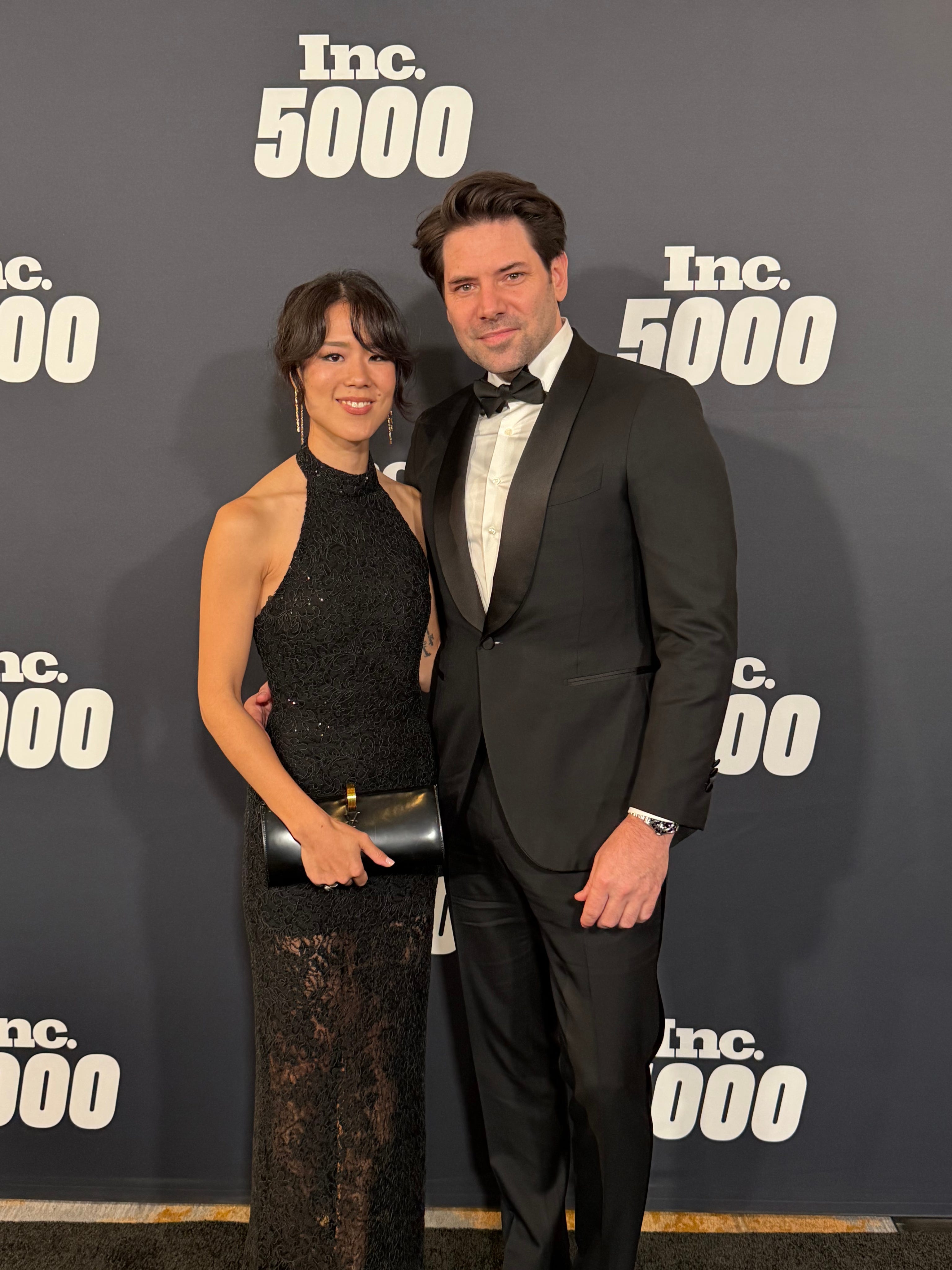
It took me a little while to post this. A lot happened in 2026. In May, I found out Religion Studio had earned a spot on the Inc. 5000 list of the fastest-growing companies in the US. In August the team was acquired. In October I flew to Dallas and put on a tuxedo to celebrate one of the fastest-growing companies in the country, and it was mine.
Mostly, though, it took a while because I had to figure out what I want to do next, in the short term and the long term. I felt lost, and I didn’t want to write a post that ended with “and I don’t know what’s next.”
Now I know.
First, thank you
Before anything else, thank you.
To the team, who spent six years building things I’m proud to have my name near. To our clients, from Meta, our first client, to MyVFO, our last client, and everyone in between who trusted a studio with an edgy name to help turn their “impossible” into reality. And to everyone who referred us, rooted for us, or rode shotgun along the way.
Why I formed Religion Studio
The acquisition sent me back to a basic question. Why did I form Religion Studio in the first place?
Ultimately, I wanted to use the studio as a place to incubate my own ideas. I wanted Religion Studio to build its own projects and launch them.
I hinted at this when I announced the studio six years ago. In October 2020 I wrote on LinkedIn that “we’re more than a studio,” and that I wanted “a framework flexible enough to support a house of brands.” I didn’t say much more at the time, but that was the plan.
The challenge was always talent and capital. The promise was that if we had steady client work, we could invest in our own projects. And when people weren’t fully utilized, which happens at every studio between projects, I could staff them on our own ideas. This isn’t new. Many studios do it.
The money trap
Here’s an example. In 2023 we launched Midddle into beta. It was a chat app with AI in the middle of the conversation. You could ask it things as a group, set it to respond in a particular tone of voice, or use it to moderate a discussion. It was a really fun project. The MVP was also costly.
I had some people on the bench after a client project ended. Between our employees on iOS, design, and project management, and a few contractors on copywriting and backend, six weeks of work with no overhead at all cost north of $40,000.
That was about the third time I tried to achieve liftoff at the studio and couldn’t escape the money trap. We learned so much from those early versions that we knew the app needed more updates, and then more after that, until we found some semblance of product-market fit. I didn’t have enough capital to buy us enough rounds of iteration. So those ideas died.
Over the past six years, I probably spent close to $150,000 on our own projects: Midddle, Doge Pro, TR33TS, and others. Some had liftoff and quickly fizzled. Others died mid-development. With Doge Pro, the developers went back onto a client project the moment the client signed a follow-on SOW.
The client work was exciting, and I’m proud of it. But it didn’t get us much closer to my original vision for the company.
What changed
In early 2025 I started tinkering with AI in pretty much all of my spare time. At first the goal was practical. In order to deliver a ton of value to our clients in the age of AI, I needed to live and breathe it.
So I started building a communication and social platform, a little thing that only my fiancée and I used to chat with each other. It has gone through many iterations, and it became my running test of the state of AI. With every new model, I pushed it to do something it couldn’t do before. Along the way I built a dozen other products that she or I used: a journaling app, a to-do app, tools for SMBs, a listening room, an app that turned your iPhone into a trackpad.
The data points were hard to ignore. With every release, I could accomplish something I wasn’t able to accomplish before. I knew that on a long enough timeline, anything I could dream up, I could build by myself, and it would be excellent.
When Opus 5.5 was released on September 22, 2026, that timeline stopped feeling long. AI can now do most of the building. What it can’t do is decide what’s worth building. A product still needs a human in the loop for vision, ideation, and product management.
The realization for me was that I am that human. My head is a storm of ideas 24/7, and I’ve spent 25 years doing every job a product needs. I wrote the code early in my career, at Booz Allen after grad school and in my own ventures. I’ve run product for more than ten years. I’ve managed designers at several companies, including Religion Studio, and I’ve sold the work. One person with that background can now do all of it at once. I intend to be that person.
And for the first time, I don’t need client work to fund the vision.
What about Religion Studio?
I don’t fully understand how studios will survive in the age of AI long-term. Studios are very much needed right now, and probably more attractive than ever, because clients can get real bang for their buck. Long term, it’s unclear. Maybe companies, from startups to established businesses, will hire one person to do it all and save the overhead of a studio. Personally, I think companies will get much leaner, with each employee managing agents that do most of the work.
Which is it? Nobody knows yet.
But, what I do know is that I’m going back to my original vision, and this time I can leverage AI to help me build it…
Introducing Kobo Kobo
A few weeks ago, I created a company called Kobo Kobo. It’s my own personal workshop, a place to incubate ideas, and I’m the only person working on every facet of every product.
The Kobo Kobo website launches today, with two products in beta.
Mystic Radio is live internet radio from around the world. Every song is chosen by a DJ who lives for music, not by an algorithm. I’ve gathered more than 3,500 of the best stations in one place, so you can spin the globe, see what’s playing right now, and save the ones you love. Join the waitlist at mysticradio.com. It launches at the end of November.
Orca Knows is enterprise AI strategy, built for SMBs. Companies pay consultants $100K or more to figure out what AI should mean for their organization. Orca figures it out for your business for a fraction of the cost, and keeps the plan current as the industry changes. Join the waitlist at orcaknows.ai. It launches in December.
The experiment
Kobo Kobo is a bit of an experiment, and you’ll all watch it play out in real time. Can one person really manage a business that is fully AI enabled, and do everything?
The hard part is that Kobo Kobo isn’t one business. Every product it launches is effectively a business of its own, with its own roadmap, customers, support, marketing and bugs. Two products are manageable. I don’t know yet what happens at five or ten. Does my workload grow with every product I launch, or can the agents absorb it? That’s the real challenge, and I don’t have the answer yet.
I’m going to be pretty vocal about all of it. I’ll be writing about it on Zero to Pete, where I already share what I’m learning about building with AI. As I get more space to reflect, I’ll also write about the lessons from six years of Religion Studio.
It took Religion Studio six years and a whole team to get here. I’m excited to find out how far one person and an army of agents can get in the next six.
If you want to follow along, or just say hi, I’m at pete@kobokobo.ai.